The Future of the Steel Industry — Carina Stoettner Opens the Handelsblatt Annual Conference
In March I opened the Handelsblatt annual conference “Zukunft Stahl 2025” with a talk titled “Scenarios for the Industry of the Future.” It set out a well-grounded look at possible futures for industry and what they would mean for the steel sector.
The underlying research is available on the Themis Foresight website.
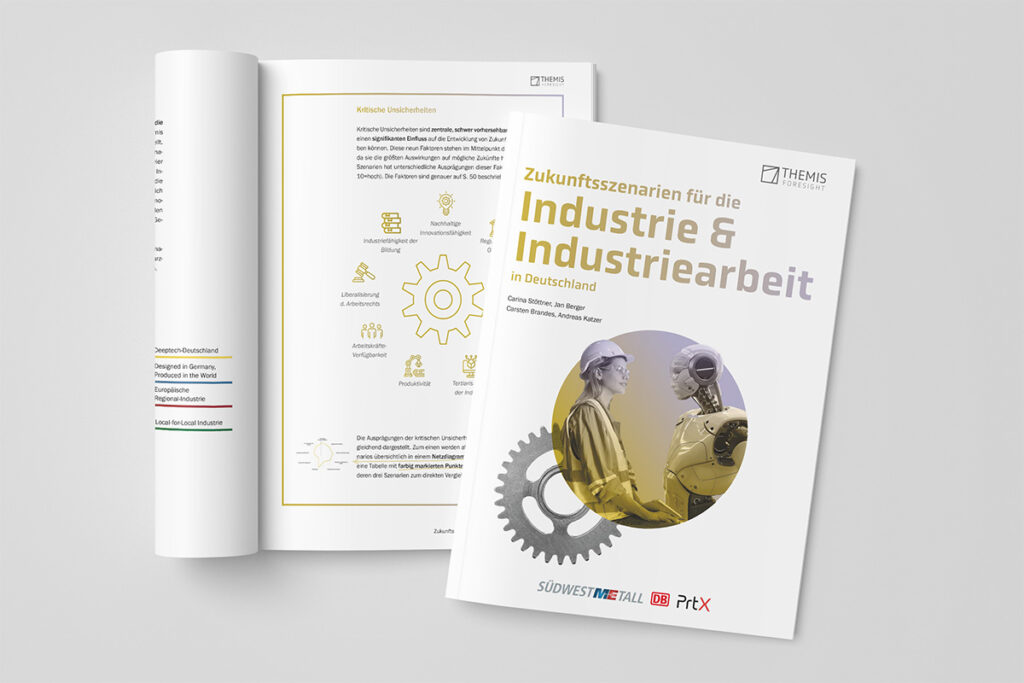
The future of steel: three scenarios for the industry of tomorrow
Are you familiar with the normalcy bias?
It describes our tendency to believe that things will stay as they are. The bias shows up most starkly in the hours before a natural disaster — a hurricane, say. You may have wondered why people stay in their houses when every forecast says clearly that a hurricane is about to pass directly over them. It’s that lingering in denial: it won’t happen to me. Or: it won’t be that bad.
That attitude is exactly what leads us to underestimate risk — and it shapes what we do about the future.
If you look at who survives times of crisis and upheaval — companies and individuals alike — a clear pattern emerges. Three phases matter.
Phase one is waking up: getting past the normalcy bias. I think we’ve all been through that one by now. After Covid, the energy crisis and the geopolitical turbulence of recent years, we know the world is changing — and that we have to change with it.
Phase two is planning. This is the decisive one. If you only start working out an exit strategy once the hurricane is already hitting your house, your options are poor. The same holds in business.
Phase three is acting — on the basis of a plan you’ve thought through.
I’d like to take you deeper into that second phase: thinking in scenarios. Unlike a hurricane, the industrial world can’t be predicted along a straight line. Which is why the famous what if matters so much. My co-authors and I developed four scenarios for the future of German industry. I’ll present three of them here.
One thing first: the point isn’t to predict exactly which future will arrive. No futurist can do that. The point is to work through possible developments using rigorous methods — in order to be prepared.
So let’s jump to 2045, twenty years ahead.
Scenario 1: Deep Tech Germany
Think of the archetypal brilliant inventor — the tinkerer with vision. That’s the type of person this scenario needs, combined with a hard-nosed commercial instinct: entrepreneurial, visionary, inventive.
In this picture of the future, Germany has become a leading deep tech location. One thing that makes it possible is new investment in security and defense — historically, a great many major innovations have come out of military research.
Today, roughly two-thirds of our industrial revenue comes from three sectors. But what if that changes? What if, by 2045, a third of revenue comes from entirely new industries — robotics, biotechnology, nanotechnology, quantum?
What is deep tech?
It isn’t about incremental improvement but about radical breakthroughs. New technologies emerging from fundamental research, with solutions to global challenges like climate change.
That requires genuine partnerships, between equals — with countries like Kenya, for instance, to develop climate-resistant crops and test them together on the ground.
What does it mean for the steel industry?
Demand for high-tech steel rises:
- for medical technology
- for aerospace
- for hydrogen technologies
- for batteries
Climate neutrality is standard in this scenario. Innovation here doesn’t mean squeezing out more efficiency — it means a revolution in materials. Steel gets rethought: its properties, its applications, how it’s made. The industry develops ultralight, heat-resistant and magnetically optimized alloys. 3D-printed steel is as real as nano-optimized materials with entirely new functionality. But competition is fierce, with new materials and new suppliers pushing into the market.
Scenario 2: Designed in Germany, produced in the world
What does it say on the back of your iPhone or your AirPods? Designed in California, assembled in China. That “Apple model” is the heart of this scenario. Germany stays strong in research, development and design — but production happens globally, and mostly elsewhere.
We’ve seen this before in textiles. Once a strong German sector, it’s now either highly specialized in niches like technical textiles or reduced to the brand — Adidas keeps marketing and design here and produces elsewhere. Other sectors could follow the same path.
For the steel industry, that means many large customers move production closer to their target markets. Keeping up requires an international presence of your own, with your own production sites. Innovation here means targeted optimization above all. Companies either improve their products technologically — highly specialized alloys, lower-carbon production processes — or they develop the business model itself. The industry could shift increasingly toward services: steel-as-a-service, in effect.
Scenario 3: A regional European industry
A protectionist Europe, responding to an increasingly closed world. The US leads, Europe follows. Reshoring and nearshoring become everyday vocabulary. “Make Europe Great Again” is the prevailing mindset.
In this regional European industry, production moves back into the EU or to neighboring countries. But it also means scarcer resources, lower design ambitions and pragmatism winning out.
A different kind of inventor comes into play here — think James Dyson reinventing the hairdryer. This scenario is about clever solutions with limited means. Innovation doesn’t mean rethinking the world from first principles; it means literally reinventing the wheel. In the spirit of: how do you build a bicycle without aluminum?
For the steel industry, that means:
- The existing customer base shrinks as export-heavy sectors like automotive come under pressure.
- At the same time, new opportunities open up — European semiconductor plants, infrastructure programs.
- Raw materials get more expensive and harder to source, but there’s less competition from global suppliers.
In summary: risks and opportunities
Risks:
- Losing traditional industrial customers
- Falling demand for commodity steel
- Raw material scarcity and rising prices
- New technological competition, particularly in deep tech
Opportunities:
- Growth through specialization and high-tech products
- Growth through new business models (“X-as-a-service”)
- Green steel as a premium segment
- New demand from reshoring and infrastructure
- Less international price pressure in the protectionist scenario
So, coming back to where we started: the normalcy bias is deceptive. Nothing stays as it is. But recognizing the risks and actively shaping the opportunities means having a hand in what the future turns out to be.
In that spirit: stay awake, stay bold — and act with foresight.
I’m happy to deliver this keynote at your event too, with the implications drawn out for your own sector.